When I was in school, math did not come naturally to me. I remember staring at numbers on the page and feeling overwhelmed, wishing there was a way to make it all click. That experience is one of the big reasons I take so much pride in creating math lessons that are hands-on, engaging, and approachable for all learners.
For some students, rounding numbers is a simple rule to memorize. For others, it feels abstract and confusing. That’s why I love to show math in multiple ways—through movement, games, visuals, and interactive notebooks. When students can touch it, see it, and do it, rounding finally makes sense.
This Rounding Numbers Sample Day is a free lesson plan designed for third grade. It includes multiple rounding activities, including a mini-lesson, a cooperative classroom activity, and an interactive notebook entry that ties everything together. These activities help students practice rounding in ways that stick—and best of all, they’re free for you to download and use with your own students.
Mini-Lesson: Pick a Stick

Start your lesson with a simple, engaging activity called Pick a Stick.
- You’ll need craft sticks labeled with two-digit numbers and cups labeled with multiples of ten (10, 20, 30, etc.).
- Each student picks a stick and decides which cup their number belongs in.
- If the number ends in 4 or less, it gets rounded down.
- If it ends in 5 or more, it rounds up.
This activity works great as a whole-group discussion or quick partner game. Students are up, moving, and actively practicing rounding in a concrete way. Instead of just hearing the rule, they see it in action.
Pick a Stick also lends itself well to classroom discussions and reteaching on the spot. If a student is unsure or places a stick in the wrong cup, you can reteach in that same moment.
Rounding Game: Follow the Clues

Next, take rounding practice to the next level with a classroom scavenger hunt called Follow the Clues.
- Post number cards around the room, each with an answer to a clue.
- Students read a clue and then go on a number search around the room.
- Once the number (or answer) is found, students record the answer and move onto the next clue.
This activity works beautifully in pairs or small groups. It promotes teamwork, problem-solving, and repetition—while also giving students the chance to check their reasoning with peers. Teachers love this activity because it keeps kids engaged and moving, which is key for maintaining energy during math time.
Interactive Notebooks: Scoop and Round
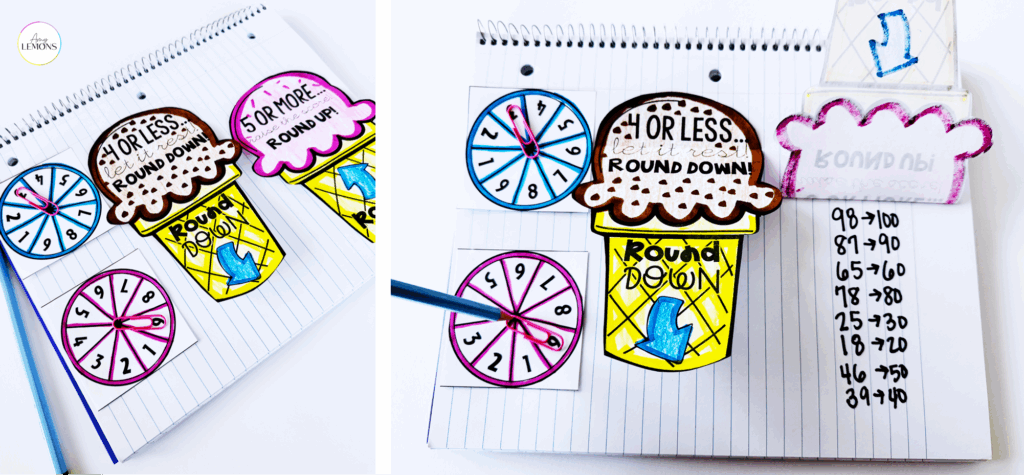
Finally, wrap up the lesson with a reflective and creative piece: Scoop and Round.
Students cut out “ice cream scoops” and spinners. After spinning to generate a number, they round it to the nearest ten and record it under the correct scoop.
This notebook activity reinforces the skill while giving students a chance to organize their thinking visually. Not only do students leave with practice, but they also build a math resource they can refer back to later in the year. Interactive notebooks are a wonderful way to track progress and create ownership of learning.
Why Hands-On Rounding Activities Work

When students explore math concepts through multiple representations—visuals, movement, discussion, and independent recording—they’re far more likely to understand and retain the skill. Some learners need to see it, some need to do it, and others need to talk through it. A day like this checks every box:
- Whole group modeling during the mini-lesson
- Kinesthetic learning during the clue activity
- Visual organization in the interactive notebook
By rounding numbers in several ways, you ensure that every learner in your classroom has an entry point to success.
Free Rounding Activities Download
You can grab all of these activities—Pick a Stick, Follow the Clues, and Scoop and Round—in one free download. Simply click below to access everything you need for your Rounding Numbers Sample Day.
Could you use extra support in making rounding numbers less of a foreign concept to your students? Check out the complete 3rd Grade Magic of Math Rounding Unit!