
Make math click
Hands-on lessons, daily word problems, partner games, and spiraled review, built on what decades of math research say helps young learners understand, remember, and enjoy math.
By Hope King & Amy Lemons · Created by educators, for K–3 classrooms
Loved by educators since 2016
Figures cover Magic of Math purchases and reviews from 2016 through October 2026. Kindergarten and the instructional lesson slides are not included in these totals.
What a Magic of Math day looks like
Lesson plans are organized by week, giving you a full weekly math curriculum built around each skill. Every day follows the same predictable rhythm, so students know what to expect and you can focus on teaching.
The suggested block from the Magic of Math teacher guides. Short on time? Choose the activities that fit and save the rest for math stations or extra practice.
A new problem every day, with strategies and student pages. Multi-step problems build toward 3rd grade state testing.
Modeling, whole-group games, anchor charts, and videos. Shifts from teaching to review as students show mastery.
Partner games, scoots, and hands-on practice. The most student-centered part of the day.
Independent practice where students show what they know, including interactive notebook pages in the upper grades. Doubles as a gradable record of learning.
Every term shown with a visual model and kept on display. Words spiral from one resource to the next.
Regular checks that mix equations, vocabulary, and word problems, so you know exactly what to reteach.


The research behind it
An analysis of six large longitudinal studies found that the math skills children bring into school predict later achievement more strongly than early reading or attention skills.
Average standardized coefficients across all observed outcomes. Duncan et al. (2007), Developmental Psychology.
Magic of Math was built around instructional practices with a strong research base, including the U.S. Department of Education’s What Works Clearinghouse (WWC) practice guides.
Hands-on learning
Students build, sort, measure, and model with real objects and pictures before moving to numbers alone. The mini-lesson guides how materials are used.
A meta-analysis of 55 studies and 7,237 students found that teaching with concrete manipulatives improved math learning over abstract-only instruction. Gains were largest for children ages 7 to 11, and teacher-guided use outperformed free exploration.Carbonneau, Marley & Selig (2013), Journal of Educational Psychology
Use concrete and semi-concrete representations to support learning of concepts and procedures.WWC: Strong evidenceWWC, Assisting Students Struggling with Mathematics (2021)
Partner games
Students practice new skills through partner games, scoots, and cooperative activities instead of worksheets.
Young children who played a simple numbered board game for just four 15-minute sessions improved in counting, numeral identification, comparing numbers, and number-line estimation, and the gains lasted nine weeks later.Ramani & Siegler (2008), Child Development
A review of 87 studies of elementary math programs found the strongest effects from programs that change daily teaching practices, including cooperative learning.Slavin & Lake (2008), Review of Educational Research
Daily word problems
Every lesson opens with a word problem of the day, and problems grow to multi-step work by 3rd grade.
Provide deliberate instruction on word problems to deepen students’ understanding and their ability to apply math ideas.WWC: Strong evidenceWWC, Assisting Students Struggling with Mathematics (2021)
Math vocabulary
Each resource includes illustrated vocabulary cards and “I can” statements that stay on display, and key words carry forward into later resources.
Teach clear and concise mathematical language and support students’ use of it to communicate their understanding.WWC: Strong evidenceWWC, Assisting Students Struggling with Mathematics (2021)
Number lines
Number lines show up for counting on in 1st grade, measurement and word problems in 2nd, and fractions in 3rd.
Use the number line to build understanding of grade-level concepts and prepare students for advanced mathematics.WWC: Strong evidenceWWC, Assisting Students Struggling with Mathematics (2021)
Spiraled review
Vocabulary spirals from one resource to the next, assessments mix problem types, and mid-year and end-of-year reviews revisit the whole year.
When 4th graders practiced mixed problem types instead of one type at a time, they scored 77% on a test the next day, compared with 38% for blocked practice.Taylor & Rohrer (2010), Applied Cognitive Psychology
In a randomized trial with 787 7th graders, mixed practice raised scores on a test given a month later from 38% to 61%.Rohrer, Dedrick, Hartwig & Cheung (2020), Journal of Educational Psychology
Quick assessments
Quick assessments, independent activities, and recording sheets show who needs reteaching before the class moves on.
A review of formative assessment research found positive relationships with math achievement when teachers collect evidence of learning and use it to adjust instruction.Palm, Andersson, Boström & Vingsle (2017), Nordic Studies in Mathematics Education
Joyful math
Teachers describe students who look forward to math. That matters for achievement, not only for the mood of the room.
Among 240 children ages 7 to 10, a positive attitude toward math predicted math achievement even after accounting for IQ, working memory, and math anxiety.Chen et al. (2018), Psychological Science
Math anxiety appears as early as 1st grade, and it held back the highest-achieving students by almost half a school year.Ramirez, Gunderson, Levine & Beilock (2013), Journal of Cognition and Development
Magic of Math in action
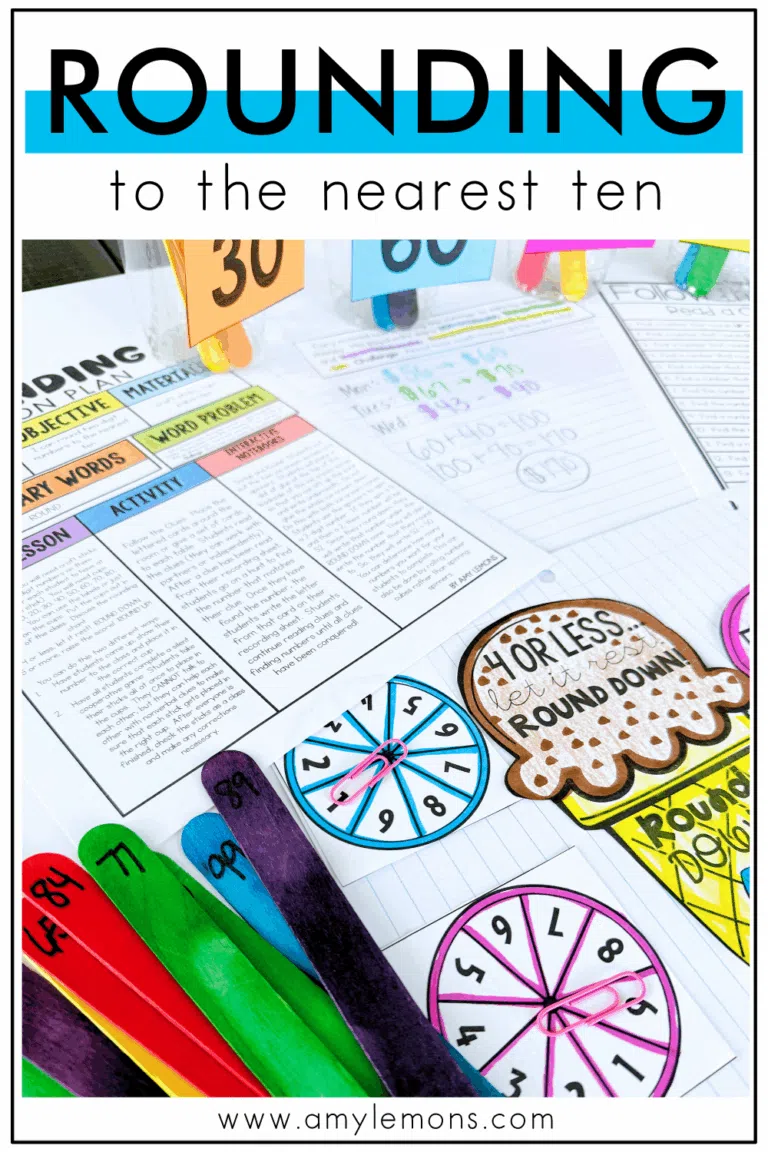
Ten frames, number sticks, spinners, scoots, and notebook pages. This is what the research looks like in a real classroom.


Year at a glance
Every resource names the Common Core and TEKS standards it teaches each week, and those standards carry through the daily objectives, activities, assessments, and review.
Districts sequence skills differently. Compare the free year overview with your district’s scope and sequence, and move or supplement resources as needed.
What teachers say
The full-year bundles alone have 2,586 written reviews. 95% rate Magic of Math 4.5 stars or higher, and only 12 rate it below 4.
I used Magic of Math years ago for 2nd grade and they loved it, I love it, their i-Ready scores went way up.
Best resource I have ever purchased. It does take some prep, but the lessons are 100% already built with really fun activities, interactive notebook glue-ins, and daily grades. My students scored the highest on the state assessment in measured growth out of all 10 classes.
I can’t recommend this resource enough! Students have never been so engaged in their learning. Students were excited every day for math time and their test scores have never been higher!
I used a textbook my first year of second grade teaching, students cried because they couldn’t understand the math and I became frustrated. This resource saved the day! Students didn’t realize they were learning; they felt like they were playing games.
I loved this for my SPED classroom for the entire year in math. It makes planning so easy. It easily aligns with the TEKS and my students are engaged daily with the variety of games and activities.
I love the lesson plans and how they are written for easy following. I was able to leave the plans with a new/training teacher and they could follow them without stumbling. My students were able to recall things from previous units with ease.
Quotes are from verified educator reviews, lightly trimmed for length. Results described are reported by the teachers.
Shop Magic of Math
Each yearlong bundle includes every Magic of Math resource for the grade, with weekly lesson plans, games, activities, vocabulary cards, and assessments. You can also shop resources one at a time.


See every resource, week, and standard before you begin.
Planning for success
Active learning takes some setup. Teachers who love Magic of Math most often mention a few habits that make the first year smooth.
From the blog



Meet the creators
Magic of Math was created from scratch by two educators who taught in K–3 classrooms and wanted math time to feel as hands-on and joyful as their best lessons.
Founder & CEO, Get Your Teach On
Hope taught in the classroom for 13 years before co-founding Get Your Teach On with her husband, Wade. She co-created Magic of Math, Write On!, and Engagement Made Easy with Amy Lemons.
Educator & curriculum author
Amy started teaching in 2006 and spent most of her classroom years in 1st and 2nd grade. She has shared lessons and activities with teachers on her blog since 2011, built around hands-on activities and meaningful books.


