

Martin Luther King Jr. is an important historical figure for students to learn about, and teachers often hunt for activities that go beyond a single read-aloud or craft but instead build real comprehension and connection.
Combining picture books with hands-on MLK activities, the lessons below focus on meaningful, easy-to-use strategies to help students better understand his life, character, and legacy. They are designed to support comprehension, character analysis, nonfiction reading, and writing in an age-appropriate and engaging way.
Picture Books About Martin Luther King Jr.

I like to begin our learning with a collection of picture books about Martin Luther King Jr. Using multiple texts helps students build background knowledge and understand his life and message from different perspectives. Some books focus on his childhood, while others highlight his role as a leader and his dream for equality.
Reading picture books about historical and influential figures together allows students to build historical context, listen for key events and ideas, prepare for deeper comprehension work, and discuss fairness, courage, and equality.
Here are a few of my favorites:
- I Have a Dream – Introduces Dr. King’s message of equality and hope.
- Martin’s Dream by Jane Kurtz – Shares key moments from his life and leadership.
- Martin Luther King, Jr. (Scholastic First Biography) – A simple, student-friendly overview of his life.
- A Picture Book of Martin Luther King, Jr. by David A. Adler – A clear nonfiction look at his work and impact.
- Martin Luther King Jr. (Scholastic Biography) – Highlights his leadership and lasting legacy.
These shared read-alouds create a strong foundation for everything that follows.
Charting Characteristics and Adjectives

After reading, we shift our focus to describing Dr. King using character traits and adjectives. As a class, students brainstorm words that describe who he was and how he acted—such as brave, hopeful, determined, and compassionate. This activity supports both character analysis and vocabulary development.
It also encourages text-based discussions and evidence-based thinking. When students explain why an adjective fits Dr. King, they must reference details and examples from the texts they’ve read.
MLK Visuals to Deepen Understanding

Hands-on projects give students an opportunity to apply their learning in a meaningful and creative way. Creating a visual representation of Dr. King helps students process information, while the accompanying writing component provides structure and support for expressing their understanding.
Using creative outlets to explore important topics reinforces key ideas from reading, builds fine motor skills, and increases engagement naturally. These projects also make powerful classroom displays that highlight both learning and student voice.
Nonfiction Texts to Enhance Fact-Based Reading
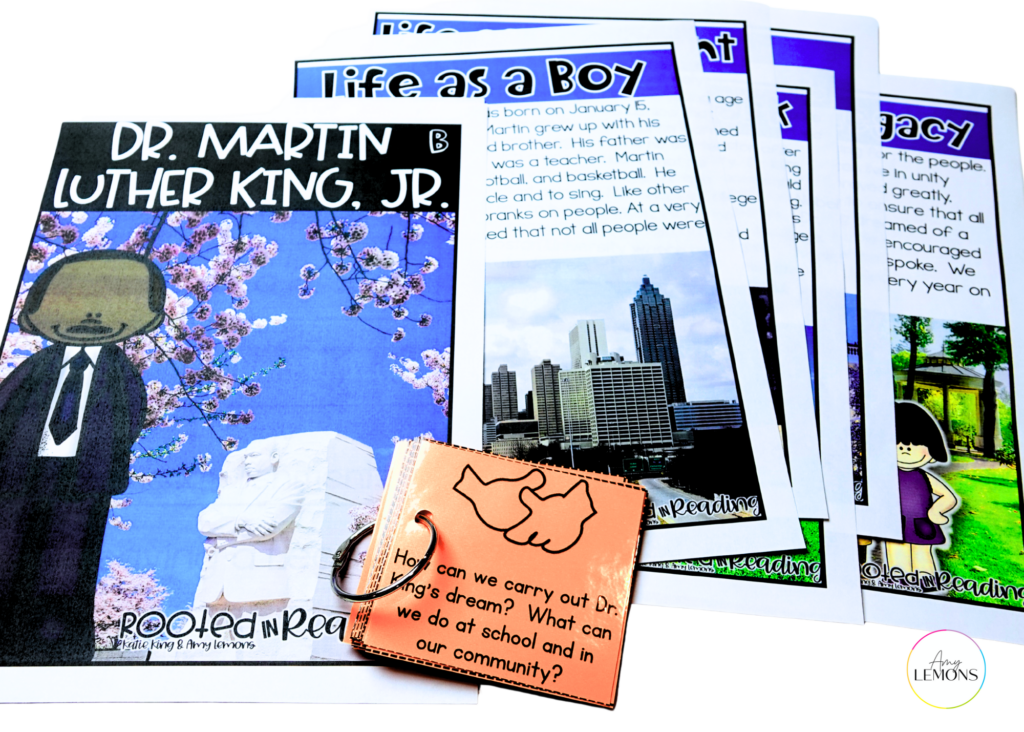
In addition to picture books, students read a short nonfiction text about Martin Luther King Jr. This helps them learn factual information about his life, including his childhood, accomplishments, and why he is remembered today.
This step is especially important for building background knowledge and strengthening nonfiction reading skills, such as:
- Identifying key details
- Understanding biographies
- Comparing fiction and nonfiction texts
- Practicing nonfiction comprehension strategies
Students deepen their understanding while preparing for future writing about real people and historical events.
Flapbook to Showcase MLK Jr.‘s Life and Legacy
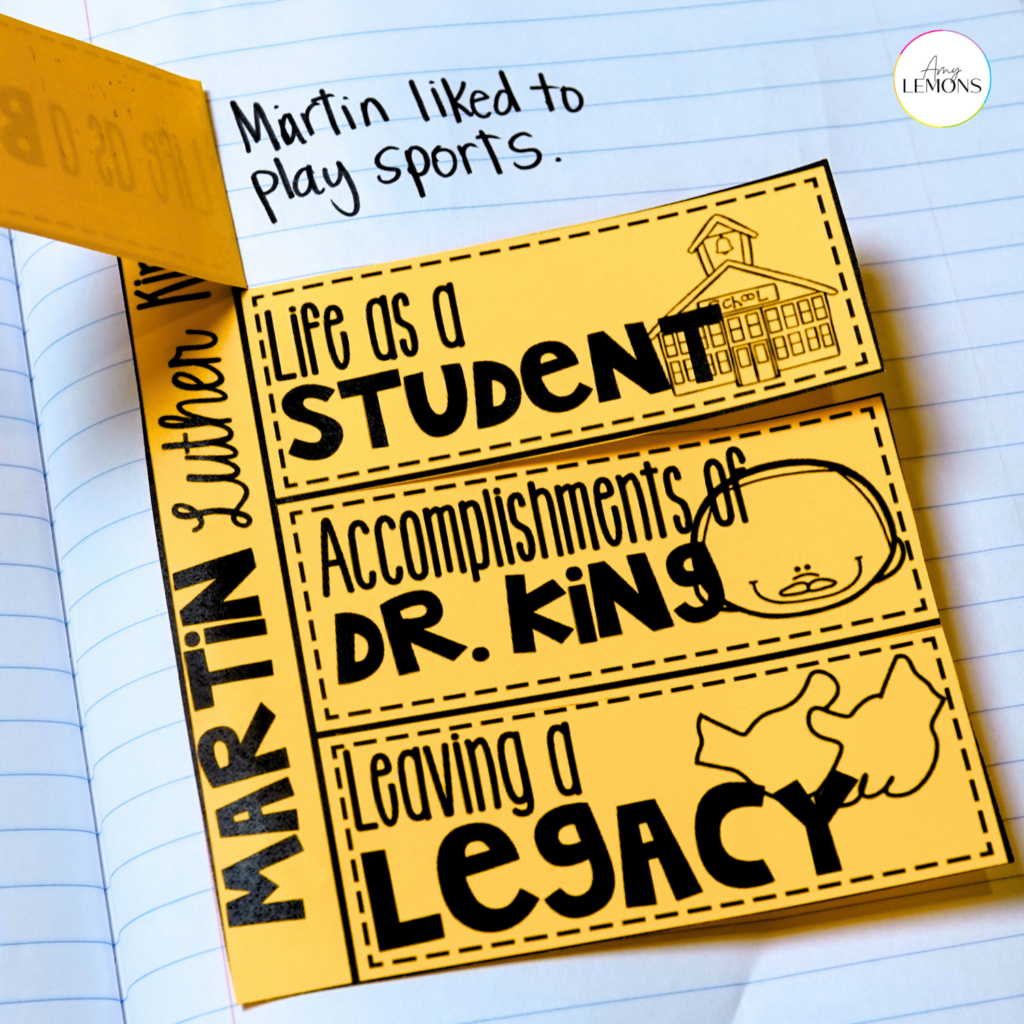
Using a flapbook, students can organize and record what they’ve learned in an interactive, student-friendly format. Each section focuses on a different part of Dr. King’s life or message, helping students break information into manageable pieces.
In addition to boosting engagement, this MLK flapbook activity supports students’ ability to organize information, summarize learning, and review key ideas in a structured way.
>>>Download the free MLK flapbook here<<<
Student Booklet: Writing About His Life

To bring everything together, students complete a booklet where they write about Martin Luther King Jr.’s life and legacy. This provides an opportunity for students to independently demonstrate their understanding while practicing informative writing.
The MLK booklet serves as a meaningful assessment of sentence development and students’ ability to use facts from text. It also becomes a keepsake of their learning—something they can revisit as they continue building historical knowledge and reflecting on influential leaders.

7 Responses
Thank you for the great resources!! Are the MLK activities available separately from the rooted in reading pack?
Oh Amy! Your products and blog posts are always spot on! Perfection as always!
I didn't see a ling to the nonfiction reader…would like to purchase =)
The Non-fiction reader is not in the updated version that I just downloaded. Is it somewhere else? i have searched the entire packet.
Amy I love that you post your activities before doing them with your class, just because I am doing the same book and was able to add this before I teach it!!! 🙂 Love all your products!!
Cindy, I just checked and it's in there 🙂 Look in the MLK unit in the comprehension section
Thank you so much for sharking. I will be using these videos with my class!