If you’ve ever watched your students guess their way through addition facts, you know the struggle is real. Memorizing facts without meaning? Not exactly the path to math mastery. That’s why I’m all about teaching addition strategies in ways that are engaging, hands-on, and actually help math fact fluency stick.
Today I’m sharing three tried-and-true second grade math games for addition facts that not only reinforce important strategies—but also bring a little fun (and friendly competition!) into your math block. Whether you’re looking for partner games, small group ideas, or independent practice with a twist, these will give your students the support they need to confidently master their addition facts.
Shark Attack

Strategy: Counting On
Best for: Partners or small groups
If you’ve ever played Kaboom, you’ll love this math twist with a bite! In Shark Attack, students use the counting on strategy to solve basic addition facts—but there’s a catch (literally).
Here’s how it works:
- Students draw a math fact strip from a bag.
- They use the counting on strategy to solve it. If they’re correct, they keep the strip.
- If they’re wrong, they toss it back.
- If they pull a Shark Attack card—yikes! All their strips go back into the bag.
The game continues until time’s up. The student with the most strips wins. It’s fast-paced, strategic, and just the right amount of silly to keep everyone engaged. Consider this one for a fun math station!
Teacher Tip: Add a little shark music – think Jaws- in the background to up the drama!
Popping Through Doubles

Strategy: Doubles and Doubles +1
Best for: Small groups (2–3 students)
This one’s a classroom favorite, especially for helping students internalize those foundational doubles facts. And because it builds up to doubles +1, it’s a great scaffolded way to deepen their number sense.

Here’s the play-by-play:
- Students take turns drawing a popcorn card with an equation.
- Everyone in the group solves it on a spiral or dry-erase board using the doubles or doubles +1 strategy.
- Once everyone has an answer, the student who drew the card reveals the correct solution.
- If they get it right, they keep the popcorn!
At the end of the game, the student with the most popcorn is the doubles champion. (And no worries—no real popcorn was harmed in the making of this game, though you could tie it into a popcorn party if you’re feeling extra fun.)
Fishing for Tens

Strategy: Making Tens with a Ten Frame
Best for: Partners
There’s something about food-themed math that just clicks with kids—and this one might be my favorite. In Fishing for Tens, students work on using tens strategies with manipulatives (and yes, a little snack).
Here’s how it works:
- Students draw an equation card (like 8 + 6).
- They use goldfish crackers to build the first number and red jellyfish (candy or counters) for the second on their tens frame.
- Then, they make a ten by “borrowing” some from the second number (8 + 2 = 10, then 10 + 4 = 14).
- Students rewrite and solve the new equation in their math journals.
This is such a powerful visual for making ten and understanding how to break apart numbers. Bonus: your students might start to see ten as their best math friend.
Flip Flop the Addends
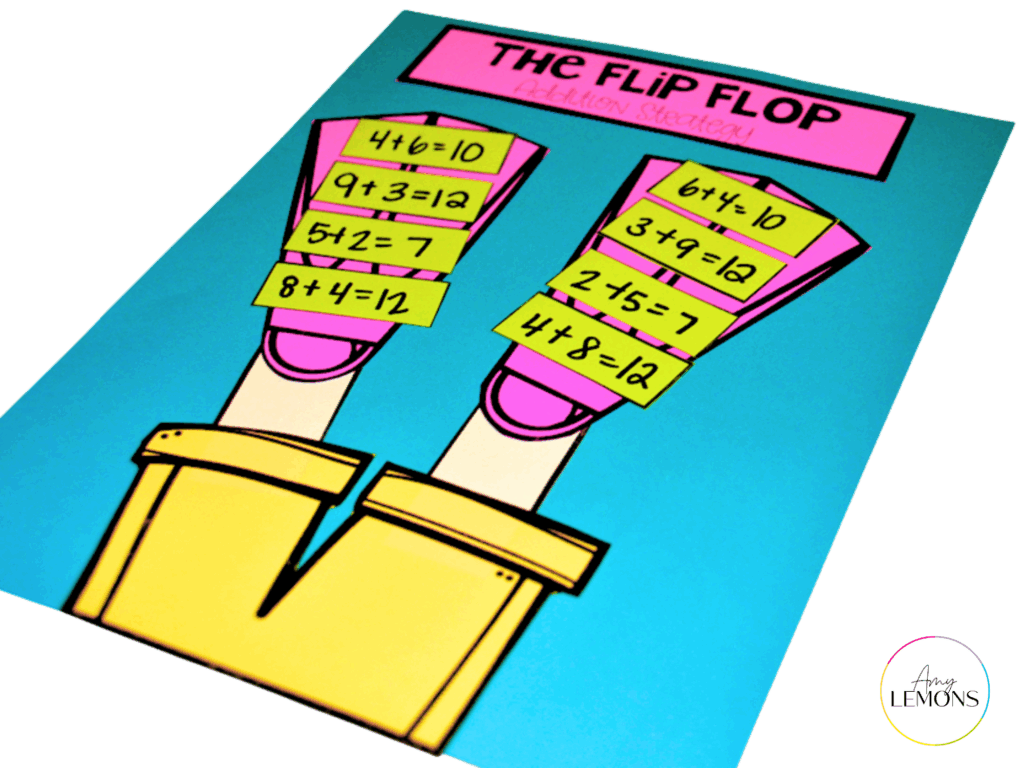
Strategy: Commutative Property of Addition
Best for: Independent Practice or Math Centers
Ready to let your students flip out over elementary math—in a good way? This craft-turned-math-activity is a fun and visual way to teach the commutative property of addition (a fancy term for the idea that 4 + 3 and 3 + 4 give you the same sum).

Here’s what it looks like:
- Students build a simple flippers craft (or simply color the printable)
- They roll two dice and write the equation they rolled (like 5 + 2).
- Then they flip the addends (2 + 5) and solve again.
- They can use any strategy they’ve learned during the week to solve each equation.
It’s a creative way to help students see that the order of addends doesn’t change the total—and it adds a splash of art into your math block. Win-win!
The Key to Mastering 2nd Grade Addition Facts
Teaching addition facts doesn’t have to be about flash cards and drills. When we give our students tools and strategies they can actually use—and wrap those strategies in games and hands-on fun—they build confidence, fluency, and number sense all at once.
If you’re looking to bring more math movement and meaning into your classroom, I hope these math games give you a great place to start. Let me know if you try them—or better yet, tag me in a picture when your students are “fishing,” “popping,” or getting caught in a “shark attack!”