“Turn and talk to your partner!”
It sounds simple enough, right? Until you look around the classroom and realize one student has been talking the entire time, another pair is staring at each other waiting for someone to go first, and somehow the students in the back are talking about what they brought for lunch.
We’ve all been there!
What Is Turn and Talk?
Turn and Talk is a classroom routine where students pause in the middle of a lesson, turn to a partner, and respond to a specific question or prompt. It usually takes less than a minute, and it works in any subject. Instead of one student answering while everyone else waits, every student is thinking, talking, and processing at the same time.
It’s one of those strategies we use ALL the time, and for good reason. It allows students to process their thinking, put their ideas into words, listen to someone else, and actively participate in the learning.
But here’s the thing: Turn and Talk is a classroom routine that has to be taught.
We spend so much time teaching students how to line up, transition between activities, gather supplies, work independently, and move through our classroom. Academic conversations deserve that same intentionality.
When we actually teach students HOW to Turn and Talk, those few minutes of partner conversation can become incredibly powerful. Students aren’t just talking. They are thinking, listening, explaining, responding, and learning from one another.
So, how do we get there?
1. Start by Teaching What Turn and Talk Looks Like (and What It Doesn’t)
Before we expect students to have meaningful academic conversations, we have to teach the routine itself. Understanding how to teach Turn and Talk breaks down to one question.
What should students actually do when you say, “Turn and talk”?
Begin with simple expectations that students can understand and practice. Students learn that both partners should talk, one person talks at a time, partners look at one another, listeners pay attention, and everyone stays on topic.
This is also a GREAT opportunity for some modeling!
Instead of simply telling students what Turn and Talk should look like, show them. Grab a student and model it incorrectly first. Look around the room while your partner is talking. Interrupt them. Talk over them. Get completely off topic.
Your students will LOVE pointing out everything you are doing wrong!
Then model it correctly and compare the two. Then model it correctly and compare the two. We included Looks Like and Does Not Look Like posters in the resource so that you can keep those expectations visible after you’ve taught them.
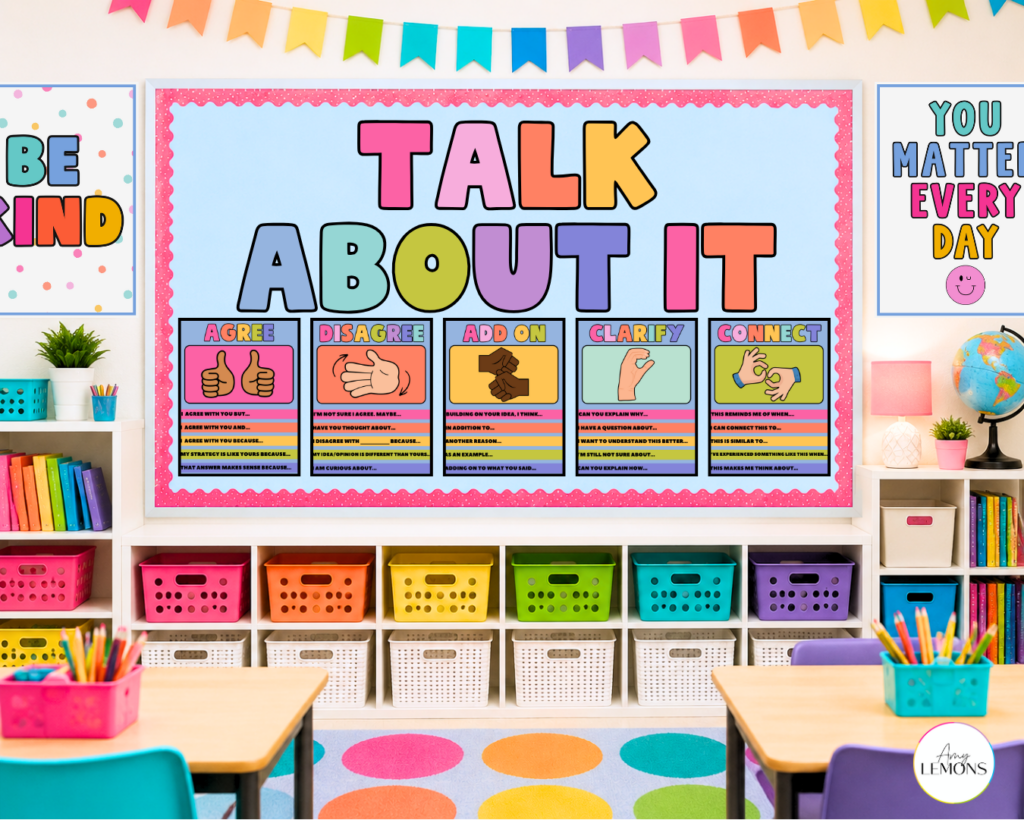
In addition, the free Turn and Talk posters allow you to hang those expectations on the wall and let them do the reminding once you’ve taught them.
This is also where I would establish some of the little routines that make Turn and Talk run smoothly. Decide how students will know who speaks first, what they should do when they finish sharing, and how you’ll bring everyone’s attention back to you. You might establish Partner A and Partner B so there isn’t an awkward pause every time students are deciding who should go first.
The goal is for students to know exactly what you mean when you say, “Turn and talk.” We don’t want to reteach the entire routine every time. We want those behaviors to eventually become automatic.
2. Teach Turn and Talk Sentence Stems for Listening and Responding
We tend to think about Turn and Talk as a speaking strategy, but half of the routine is actually listening.
And being quiet while someone else speaks isn’t necessarily the same thing as listening!
We want students actively processing what their partner is saying so that they can respond to the IDEA instead of simply waiting for their own turn to talk.
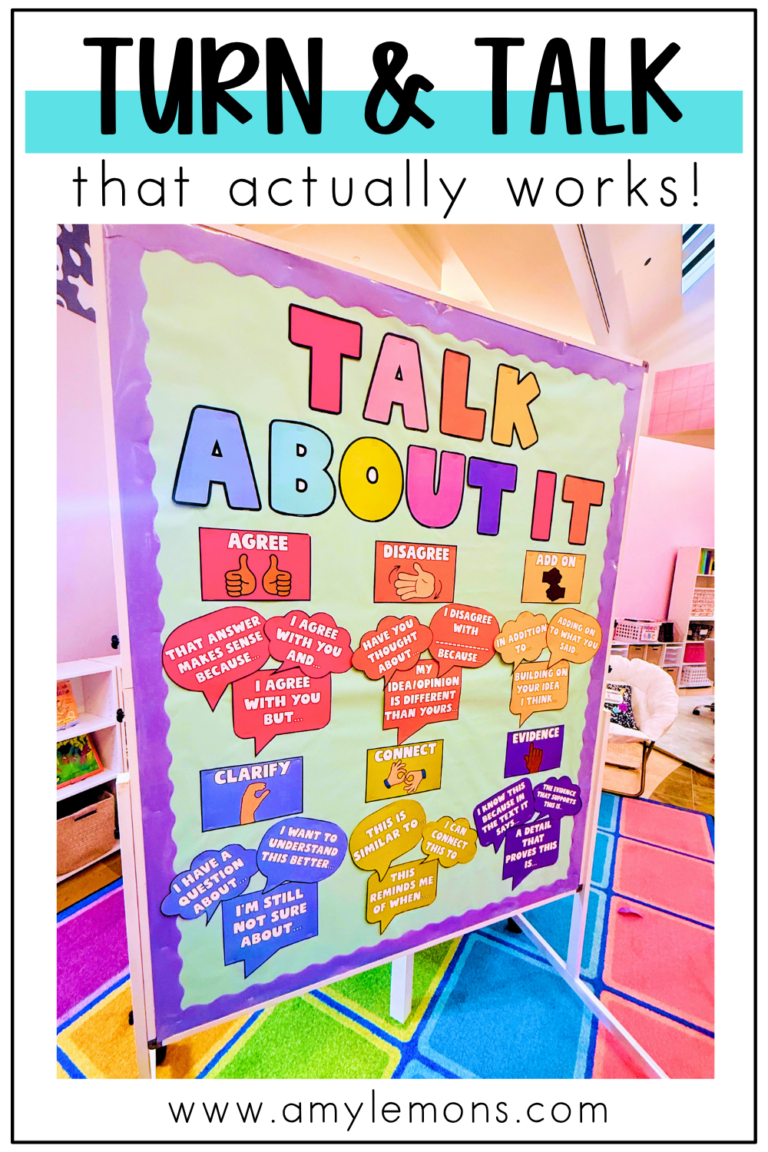
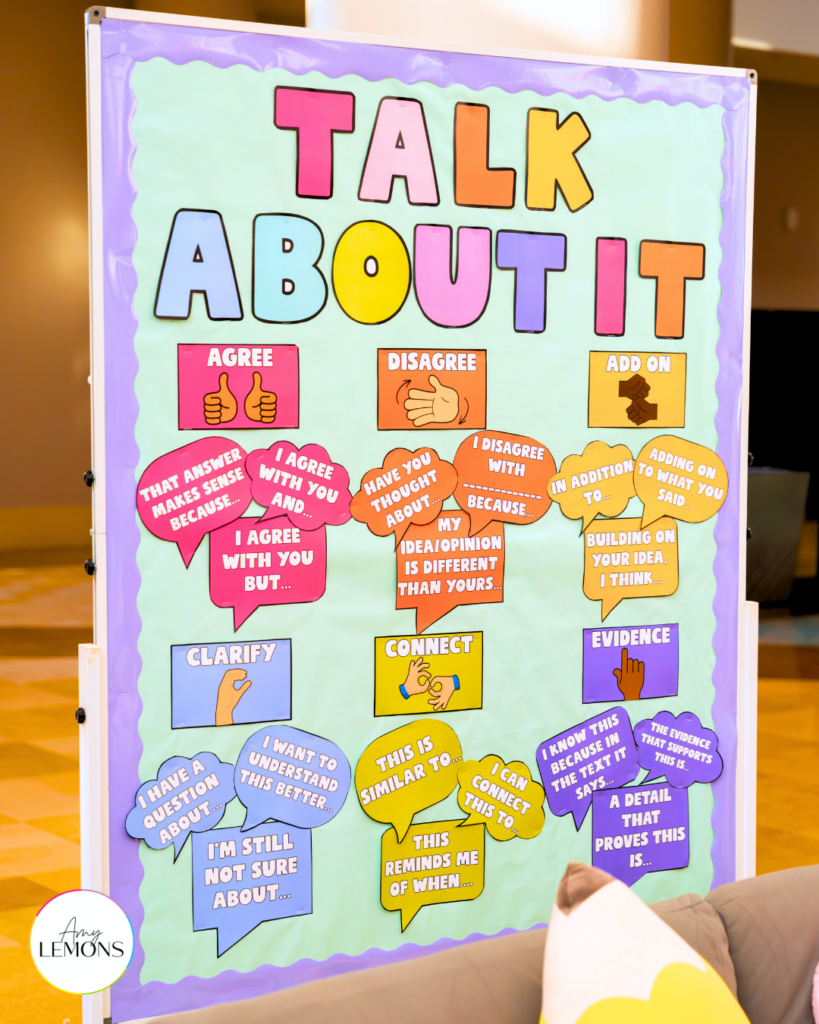
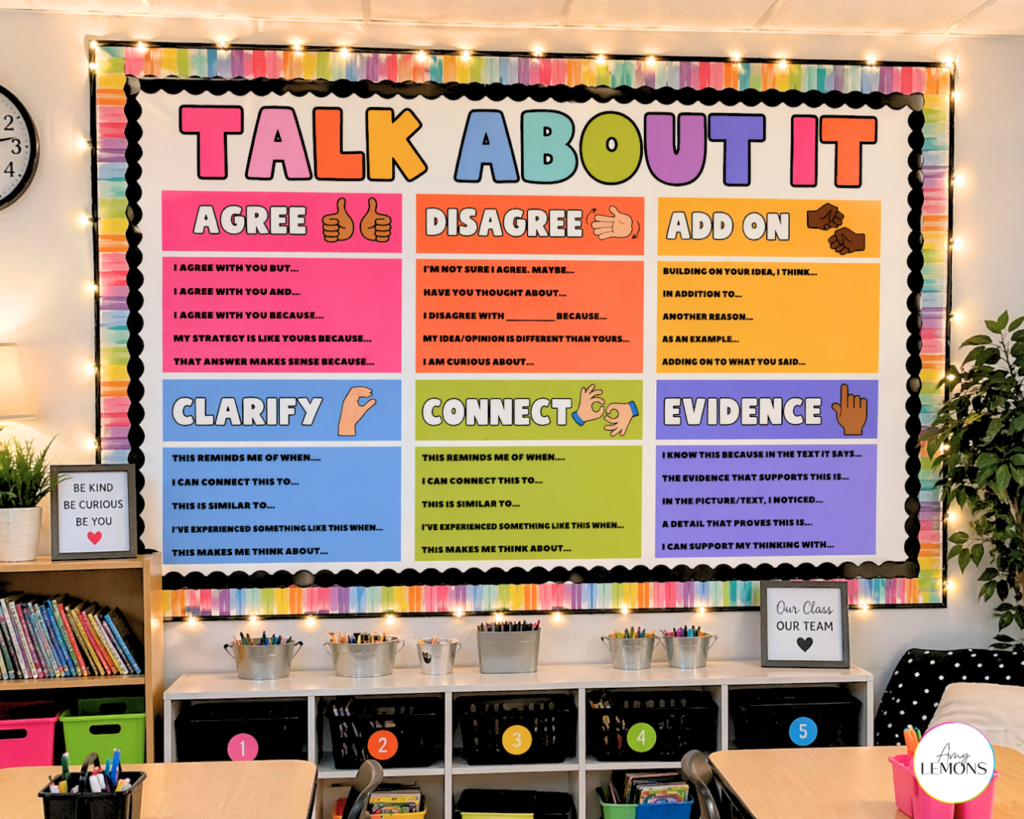
One of our favorite ways to make that thinking visible is through hand gestures. As students listen to their partner, they can show that they:
- Agree
- Disagree
- Want to add on
- Need clarification
- Can make a connection
- Have evidence to support an idea
Now the listening partner has a job! Instead of sitting quietly and waiting, they are thinking about what their partner is saying and deciding how they might respond.
You can also pair those gestures with Turn and Talk sentence stems such as:
- “I agree with you because…”
- “I disagree with you because…”
- “I’d like to add on…”
- “Can you explain why…?”
- “I can connect to that because…”
- “My evidence is…”
And PLEASE don’t feel like you have to teach all of these at once!
Start with one. Practice it. Use it over and over again. Once students are comfortable with it, add another.
The goal isn’t for students to memorize a giant list of sentence starters. We want to give them the language they need until those types of responses eventually become a natural part of their classroom conversations..
As students become more comfortable, you can continue building on these skills. The same listening and responding routines students use with one partner can eventually transfer into small-group conversations where students are responding to and building on multiple ideas.
3. Practice Partner Talk Before the Content Gets Hard
This part is so important!
When students are first learning how to Turn and Talk, we don’t necessarily want them trying to learn a brand-new academic concept at the same time. That’s a lot happening at once.
Instead, give them opportunities to practice with topics they can easily discuss.
You might ask:
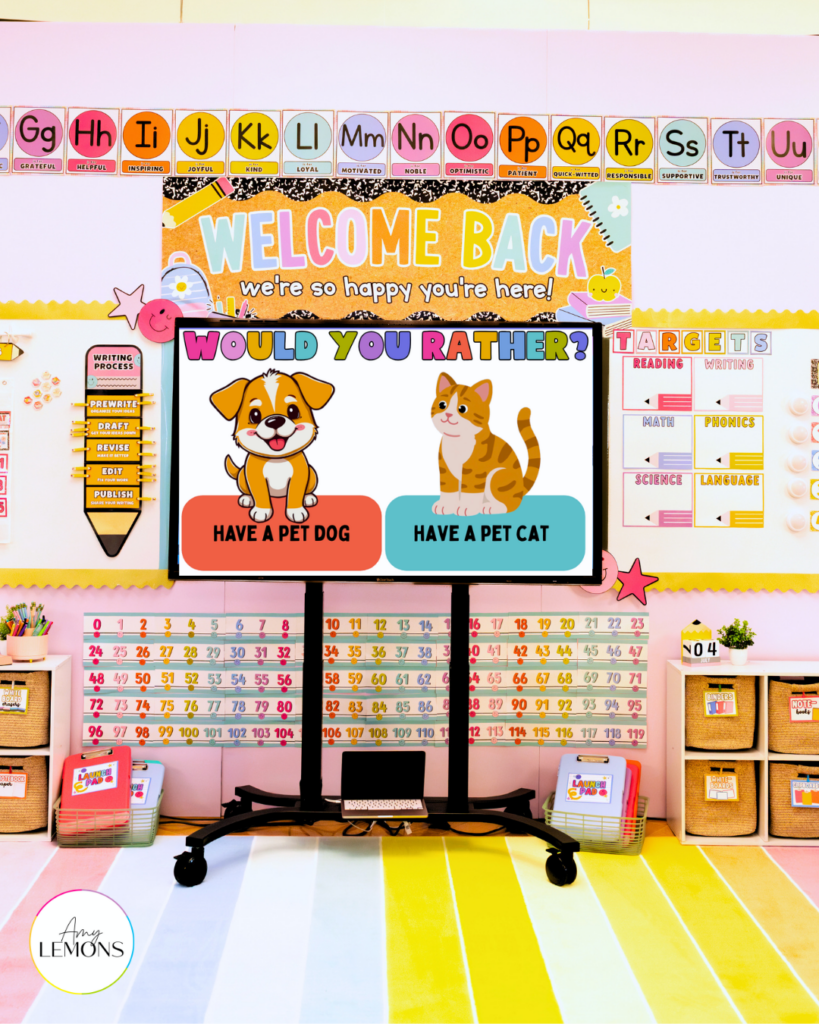
- Would you rather have a pet dog or a pet cat?
- Would you rather visit the zoo or the aquarium?
- Would you rather have recess inside or outside?
- Would you rather play a board game or a video game?
The actual question isn’t the important part. The conversation is!
While students practice, you can focus completely on the routine. Are both partners participating? Are they listening? Are they staying on topic? Are they using the conversation stem you’ve been practicing?
Once those behaviors become familiar, begin transferring the routine into academic conversations. This is where think time becomes especially important. Before asking students to Turn and Talk, give EVERY student an opportunity to develop an idea first. Depending on the lesson, they might think quietly, jot down a few words, draw a picture, solve a problem, or record a quick response.
Then, make the conversation prompt specific. Instead of saying, “Turn and talk about what we just learned,” you might say:
- Reading: “Share one clue from the text that helped you make your inference.”
- Math: “Explain which strategy you used to solve the problem and why.”
- Writing: “Read your topic sentence to your partner and explain how it connects to your opinion.”
- Science: “Tell your partner one thing you learned about the life cycle and one question you still have.”
This gives students something specific to think about AND something specific to discuss.
4. Keep Turn and Talk Short and Structured
More talking time does not automatically mean better conversations. Especially with our youngest learners!
Start small. The implementation guide in our Turn and Talk unit recommends about 20–30 seconds per speaker for K–2 students and 30–45 seconds for students in grades 3–5 while you’re still building the routine.
Give students a predictable structure:
- Think about your response.
- Partner A shares.
- Partner B listens and responds.
- Switch.
- Bring everyone back together.
You can always increase the amount of time as students become stronger conversationalists or as the complexity of the topic increases.
The goal is quality over quantity. I’d much rather have 45 seconds of focused, productive conversation than three minutes that slowly turns into a discussion about recess!
As students get better at this routine, you can also begin giving them more independence. Eventually, students shouldn’t need us directing every single move. The goal is to build strong enough conversation habits that they can use the same skills with a partner, in a small group, and throughout the school day.
5. Use Turn and Talk as Formative Assessment
This may be one of the most valuable parts of Turn and Talk for the TEACHER.
While students are talking, don’t just circulate to make sure everyone is behaving. Listen to what they’re saying.
In a minute or two of conversations, you can start gathering information about:
- Who understands the concept
- Who is still confused
- Who can explain their reasoning
- Who has an answer but can’t explain WHY
- Who is using evidence
- Who is building on someone else’s thinking
- Who may need additional support
This gives us information we can actually USE.
Maybe you stop and clarify something for the whole class. Maybe you grab a few students for a quick small group. Maybe you realize students are ready to move on. Or maybe you realize they are absolutely NOT ready to move on. Ha!
Either way, you know more than you did before the conversation.
That’s when Turn and Talk becomes more than an engagement strategy. It becomes formative assessment happening right in the middle of your lesson.
Turn and Talk Is About So Much More Than Talking
When we tell students to Turn and Talk, we are actually asking them to do quite a bit. They have to think about their own ideas, communicate them clearly, listen to someone else’s thinking, process what they heard, compare ideas, respond appropriately, and stay focused on the topic.
Those are skills worth taking the time to teach!
And once the routine is established, you can use it EVERYWHERE: reading, math, writing, science, social studies, whole-group lessons, small groups, and just about anywhere else you want students doing more of the thinking and talking.
The few minutes we spend teaching students HOW to have these conversations can make all of those Turn and Talk moments throughout the year so much more meaningful.
If you want the posters, the sentence stems, and the full teaching sequence already built for you, everything is in the Turn and Talk unit.